Post sponsored by PantryWise – The All In ONE Kitchen/Pantry App. Find out what you can cook with what you already have, build out grocery lists, connect your Kroger account and import previous orders, and much more!

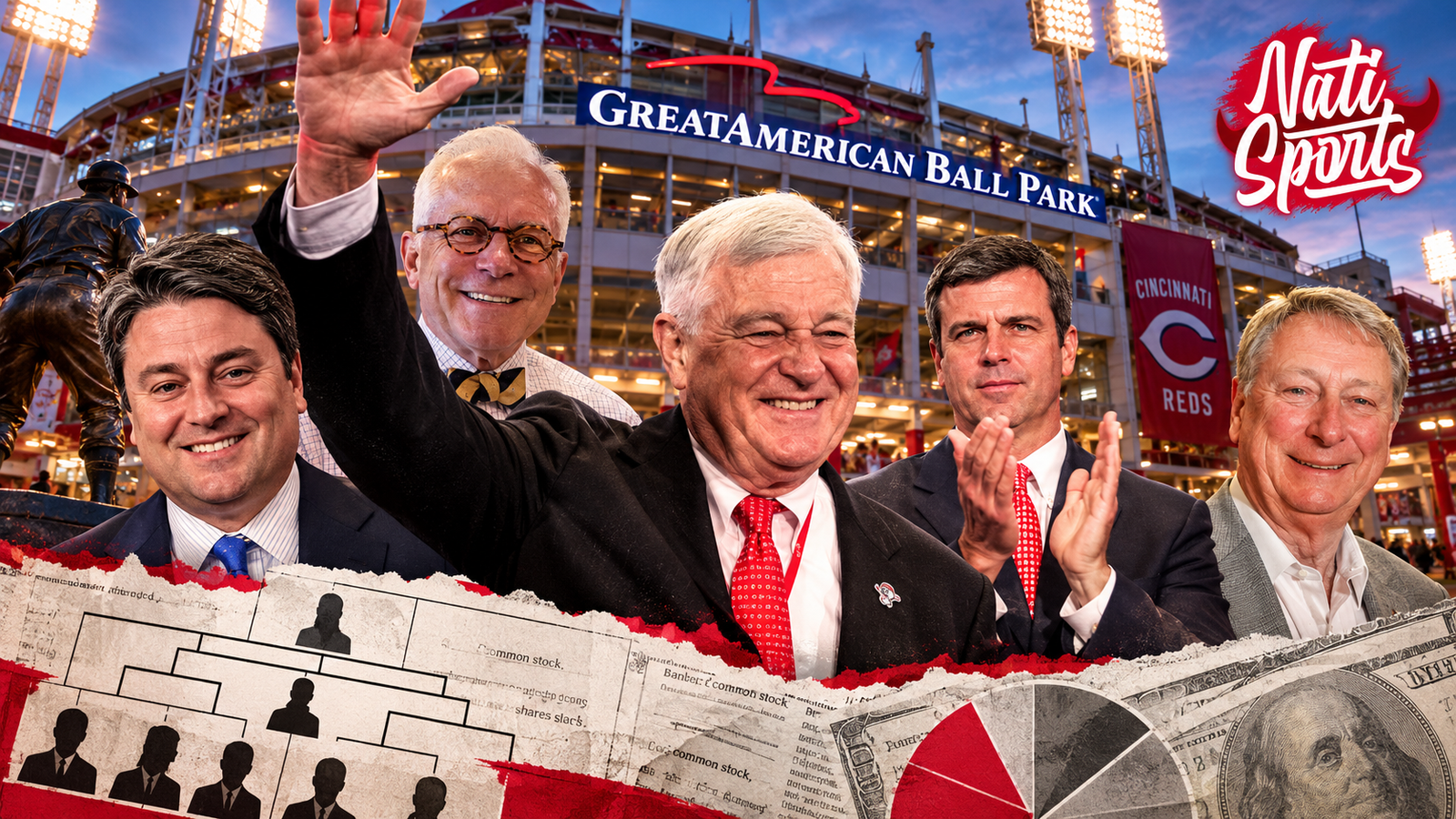
For most Cincinnati Reds fans, the team’s ownership structure seems simple.
For two decades, Bob Castellini was “the owner.” Now his son, Phil Castellini, is “the owner.”
Except neither description tells the full story. Let’s get into it. But first, subscribe to our Newsletter by using the popup or the form below! Also, if you’re someone close with one of the owners cited here and have definitive information on any of the points made in this article, reach out to us and we will alter and tell your side of the story: contact@natisports.net
The Cincinnati Reds aren’t owned by one person or even one family. They are owned by a sprawling collection of wealthy Cincinnatians, businessmen, investment groups, LLCs and estates whose economic interests do not necessarily correspond with their ability to control the franchise. That means…they simply are there just to collect a check every year. For some, not as lucrative as you think.
And the deeper you dig into how the Reds are actually owned, the stranger it gets..the worse it gets.
Public reporting has described a franchise divided into 27 economic shares and an ownership group containing 19 investors or investment entities (LLCs, meaning many different buy ins.) Some reportedly own multiple shares. Others appear to own only one. Some interests have voting rights. Others reportedly do not.
And despite the Castellini family’s relatively modest percentage of the total economic ownership traditionally attributed to it, control of the Cincinnati Reds has remained with the Castellini family.
In February 2026, Major League Baseball owners approved the transfer of control from Bob Castellini to his son, Phil.
That part is definitive.
Exactly how the underlying economic and voting interests are currently distributed is not, and is why I wanted to go into this in depth, because most of Reds Country has no idea how this all works.
And that distinction is the key to understanding what may be one of the most dysfunctional ownership structures in Major League Baseball — and perhaps one of the strangest and dare I say WORST in all of American professional sports.

The Reds aren’t really “owned by the Castellinis”
When Bob Castellini’s group took control of the Reds in January 2006, contemporary reports described the transaction somewhat differently, but agreed on the basic picture: a group led by (Bob) Castellini and brothers W. Joseph Williams Jr. and Thomas L. Williams (former President of Ops Dick Williams Father & Uncle) acquired a controlling stake in the franchise.
Sports Business Journal reported at the time that the group would acquire roughly 70-75% of the club, while existing owners including Carl Lindner, William Reik, George Strike and the Louise Nippert Trust retained minority interests. Most still remaining today.
The franchise was reported to have been valued at approximately $270 million in connection with the transaction.
But here’s where things get interesting…
The ownership group that emerged wasn’t simply Bob Castellini owning 70% of the Reds. Far from it.
The Reds ownership group is split between 27 financial ownership shares.
If that structure remains intact, simple math means each share represents approximately:
3.7% of the Cincinnati Reds.
The same reporting says Bob Castellini held four of those shares.
Four out of 27 is approximately:
14.8%.
That’s where the commonly cited figure that the Castellini interest owns “about 15%” of the Reds comes from. Not to mention, that 15% figure it what it LITERALLY takes to own the ‘majority’ stake in an MLB team, per MLB’s own rules. That majority stake is what the Castellini family owns.
But there is an enormous caveat.
The Reds are a privately held company. There is no publicly available SEC-style cap table showing exactly who owns every share, what rights are attached to every share, or how those interests may have changed over the last 20 years.
So while the 27-share structure and roughly 15% Castellini figure have been reported, WE cannot independently verify the current ownership agreement. There’s been rumors of Castellini buying out more shares from other minority owners, but never confirmed in the media or by any outlet.
That distinction matters. Because what we can definitively establish is even more important.
The Castellinis control the Reds. That we know. MLB knows. MLB Owners know. The fans know. But it probably isn’t like you thought.
Twenty-seven pieces of the pie – Cincinnati Reds Ownership Structure
The Reds’ official media guide has identified 19 members of the ownership group.
They include:
- The Castellini interest
- W. Joseph Williams Jr.
- Thomas L. Williams
- Lindner Reds Baseball IV LLC
- Frank Cohen
- William J. Reik
- Buy Buy Baseball LLC
- EMK Investment Company LLC
- Larry Sheakley
- Jeffrey L. Wyler
- Harry J. Fath
- Jeffrey L. Gendell
- Edwin J. Rigaud / AACE
- HKR Baseball LLC
- Ronald L. Sargent
- John H. Wyant
- George H. Vincent / Queen City Diamond LLC
- Heading for Home LLC
- Art Hauser
Even that list understates how many people potentially have an economic interest in the franchise. Many folks could be tucked behind these LLCs. Some of the listed “owners” aren’t people at all. They’re LLCs or investment groups that themselves can contain multiple investors. It’s known there’s investment bankers, Cincinnati home builders, and even prominent lawyers tucked behind some of these.
AACE, for example, was formed as a group of Black Cincinnati investors. Queen City Diamond is another investor group. Buy Buy Baseball LLC has been associated with the family of late Broadway producer Rick Steiner.
So “19 owners” doesn’t necessarily mean 19 human beings.
It means 19 ownership interests listed by the club. That’s where it gets messy.
The actual number of people with an indirect financial stake in the Cincinnati Reds could be larger, in fact, I CAN independently verify that to be the case.
The 13 shares that explain everything
This may be the most important piece of the entire story.
According to Reds Content Plus’ (credit to them for this piece) reconstruction of the 2006 transaction, Castellini raised approximately $84.5 million toward the purchase by selling 13 ownership shares for $6.5 million apiece.
The math checks:
13 × $6.5 million = $84.5 million.
But those 13 shares were reportedly non-voting shares. Read that again.
Investors could own a meaningful economic piece of the Cincinnati Reds without receiving an equivalent voice in controlling the organization.
If the 27-share structure remains unchanged, those 13 non-voting interests would collectively represent roughly 48% of the economic equity of the franchise.
Yet economic ownership and voting control are two entirely different things.
And that may explain one of the most confusing questions Reds fans have asked for years:
If the Castellinis only own around 15% of the Reds, why can’t the other owners simply overrule them?
Because owning 15% of the economics does not necessarily mean controlling only 15% of the votes.
The Williams family makes this even stranger
Joe and Tom Williams weren’t insignificant investors brought aboard after the deal. They were central figures in the group that acquired control of the Reds in 2006.
Contemporary Sports Business Journal reporting described Bob Castellini, Joe Williams and Tom Williams as the managing members who would hold operating control of Cincinnati Reds LLC, with Castellini serving as the public face of the ownership group and handling dealings with the commissioner’s office and other MLB owners.
The Williams family remains deeply connected to the franchise.
Joe Williams is chairman of the Reds. Tom Williams is vice chairman. Former Reds president of baseball operations Dick Williams is Joe’s son.
Various attempts to reconstruct the ownership structure have suggested the Williams interests may collectively own an economic stake comparable to or even greater than the Castellini interest.
But this is another place where precision matters.
The Reds do not publicly disclose a current ownership table showing exactly how many shares Joe and Tom Williams own.
Any claim that the Williams family definitively owns a specific percentage should therefore be treated as an estimate unless the underlying ownership documents become public.
Still, it illustrates the bizarre nature of this structure.
It is entirely possible for another family or combination of investors to have more economic exposure to the Reds than the family that actually controls the franchise.
The Lindners never completely left
There’s another misconception worth clearing up. Carl Lindner sold control of the Reds in 2006 but he did not completely sell out of the franchise. Contemporary reporting indicated that Lindner and longtime investor William Reik would each retain approximately 8% of the Reds, although those percentages were still subject to change as the new ownership group was assembled.
Today, Lindner Reds Baseball IV LLC remains listed among the Reds’ investors. William Reik remains on the ownership list as well.
Reds Content Plus’ reconstruction of the later 27-share structure assigns two shares to the Lindner interest and two to Reik, which would represent roughly 7.4% each.
Again, those exact present-day percentages should be considered reported estimates rather than a publicly disclosed current cap table.
But the broader fact is clear:
The previous Reds ownership group never completely disappeared. Parts of it were folded into the new one.
There’s even a piece of the Big Red Machine ownership lineage left
One Reds ownership interest can be traced through another era entirely.
Louis and Louise Nippert became Reds investors in 1966. The Nipperts eventually acquired majority control of the franchise in 1973 and owned the Reds during the Big Red Machine’s back-to-back World Series championships.
The family later sold majority control but retained a minority interest.
After Louise Nippert died in 2012, the Louise Dieterle Nippert Trust still held that stake.
In 2014, the Reds approved the sale of the trust’s interest to Cincinnati native and Blackstone executive Frank Cohen.
The Cincinnati Enquirer reported Cohen acquired less than 5% of the franchise.
If the interest represented one of the reported 27 ownership units, it would be approximately 3.7%.
So part of today’s ownership structure can effectively be traced:
Nippert family → Nippert Trust → Frank Cohen.
This isn’t an ownership group that was built cleanly in 2006.
It is almost an archaeological record of different eras of Cincinnati Reds ownership.
Then the Castellinis transferred control — within the family
For years, Bob Castellini was officially the Reds’ principal owner and managing partner.
When the Reds promoted Phil Castellini to president and CEO effective August 1, 2024, the organization specifically stated that Bob would retain “control and managerial responsibility over all business and baseball operations.”
There was no ambiguity. Bob remained in charge… then came the cold morning of February 12, 2026. Major League Baseball owners approved the transfer of control of the Cincinnati Reds from Bob Castellini to Phil Castellini. The Reds described it as the conclusion of the succession process that began with the 2024 organizational changes when Doug Healy was promoted to CFO as well.
So there is no need to speculate about who MLB recognizes as the controlling owner today.
It’s Phil Castellini.
There has been considerable discussion and speculation surrounding the Castellini family’s ownership percentage and control of the voting interests. The most commonly reported reconstruction suggests the Castellini interest represents roughly four of the 27 economic shares while possessing enough voting authority to control the club. But as we’ve stated before, it has been reported that Castellini has attempted to buyout a few minority owners to increase his stake in the team.
But that should not be presented as an indisputable current fact without access to the operating agreement.
What is indisputable is that MLB approved Phil Castellini as the person controlling the Cincinnati Reds.
And that is exactly why this structure is a problem
This isn’t an argument that having minority investors is unusual. It isn’t. Professional sports franchises routinely have ownership groups. MLB has plenty of them. The problem is the combination of fragmentation, unequal voting power, limited transparency and concentrated control.
Consider what Reds fans are left trying to understand. There are 19 publicly listed ownership interests. There are reportedly 27 economic shares. Nearly half of those shares were reportedly created as non-voting interests. Several ownership slots are themselves LLCs or investment groups containing additional investors.
Some families appear to control multiple shares.
Some investors date back to ownership groups that preceded Castellini.
And the family controlling the organization appears to hold only a minority of its total economic equity.
That’s not inherently illegal, improper or even unprecedented.
But from the standpoint of accountability?
It’s a mess. It’s a mess we’ve known about for a long time. It’s a mess we’re still sitting here trying to figure out who we need to point our fingers at.
Who do Reds fans actually hold accountable?
This is where the structure becomes particularly problematic for a professional sports franchise.
When the Reds cut payroll, who made that decision? Who should we be pissed at?
When the Reds increase payroll, whose money is actually being risked?
If ownership decides it cannot afford another $20 million in player salaries, is that a decision made by the controlling owner? The voting owners? All 19 ownership interests? Does every investor receive distributions? Can capital calls be made? Can minority investors voluntarily inject additional money? What restrictions exist on transferring shares?
Could a group of minority investors force a sale?
What percentage of voting interests does the Castellini family actually control today?
What percentage of the team’s economic equity does Phil Castellini personally own?
We simply don’t have public answers to many of those questions.
And that matters because Cincinnati has spent years hearing arguments about the financial limitations of operating a small-market baseball team. I’ve made countless tweets about ‘Selling the team’ – who even decides that?
If finances are going to be central to the organization’s explanation for how it operates, understanding who actually owns the organization and who actually controls its money becomes extremely relevant. Isn’t this something us Reds fans deserve to know? This ownership group has given us winning seasons 7 times in two decades. 3 of those seasons they barely scraped .500.
Imagine owning more of the team than the person running it — and potentially having less power
This is the fundamental absurdity of the Reds’ structure. Economic ownership and voting control don’t have to be proportional.
That’s perfectly legitimate corporate governance.
But apply that concept to a professional sports franchise.
An investor could theoretically have millions — perhaps tens of millions today — tied to the Cincinnati Reds and still possess relatively little ability to influence the direction of the organization.
Meanwhile, a family controlling a minority of the economic equity can maintain control through voting rights and MLB’s control-person structure.
That creates an extraordinary concentration of authority without requiring majority economic ownership.
And when control can then be transferred from father to son without the franchise itself being sold, the result is a structure in which the identity of the person running the Cincinnati Reds can change while the sprawling collection of minority investors largely remains in place.
That’s remarkable.
Is it actually the worst ownership structure in Major League Baseball?
There is no objective statistic called “Worst Ownership Structure.”
We aren’t going to pretend there is.
Plenty of professional sports franchises have complicated ownership arrangements. Some are controlled by families. Some have dozens of limited partners. Some use holding companies, trusts and multiple layers of LLCs.
But the Reds deserve to be in the conversation for the worst structure in professional sports from the standpoint of transparency and accountability. And you know what, yeah. This is the worst structure in sports. Easily. And the team has performed like it, too.
The biggest misconception about Reds ownership
Fans frequently say:
“The Castellinis own the Reds.”
A more accurate sentence would be:
The Castellinis control the Reds.
There is a major difference.
The Cincinnati Reds are owned collectively by a large private investment group.
The Castellinis are part of that group.
The Williams family is part of it. Perhaps, owning the biggest piece.
The Lindner interest remains part of it.
William Reik is part of it.
Frank Cohen is part of it.
Larry Sheakley, Jeff Wyler, Harry Fath and numerous other individuals and investment entities are part of it.
And yet Major League Baseball recognizes Phil Castellini as the controlling owner.
That may be the most important fact in this entire story, especially since most fans know this.
The Reds need more transparency
Nobody should expect a privately held baseball franchise to publish every page of its operating agreement. But there is a reasonable middle ground. The Reds could tell our fans:
How many economic ownership units exist today.
How many voting units exist in total.
Which ownership interests possess voting rights.
Approximately what percentage is controlled by the Castellini family.
Whether the 27-share structure reported publicly remains accurate to this 2026 date.
Whether Phil Castellini personally acquired additional equity as part of the 2026 transfer of control.
And why the f**k Nick Krall is still employed as the President of Operations.
Until then, we’re left reconstructing the ownership of one of baseball’s oldest franchises from media guides, 20-year-old transaction reports, LLC records, subsequent minority-interest sales and reporting from people who have attempted to piece the puzzle together.
That shouldn’t be necessary. Especially after the monstrosity that is the modern day Cincinnati Reds all due to this horrendous ownership group and structure. We want transparency. Us knowing Bob Castellini and Phil Castellini as the majority owner is no longer good enough. We want to know who else to be upset with. Who else to blame. Who else to put pressure on. Because clearly, the pressure on the Castellini family is going through one ear and out the other. We want our proud franchise back.