
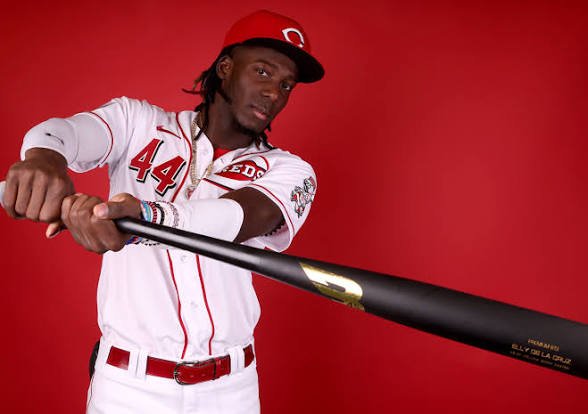
Elly De La Cruz is the future of this Reds franchise, one way or another. Either he will play out his contract in Cincinnati and move on to greener pastures, or, as Jim Bowden recently predicted, the team will try to trade him in as massive a haul as possible.
If the Reds choose to pull the trigger on a deal, it will likely be the fork in the road that leads to either continued mediocrity, or a crop of players that could become the core of a future contender.
Barring something drastic, Nick Krall will be the one who is responsible for which path the Reds wind up walking down.
In Elly, Krall will hold one of the most impressive trade chips in all of baseball. At 24 years old, De La Cruz put together a standout 2026 campaign, hitting .283 with 30 home runs, 79 RBIs, and 30 stolen bases. He has put together an impressive early career, amassing 575 hits, 90 home runs, 169 stolen bases, and a .262 lifetime average.
There have been plenty of potential trade packages thrown around. And while it’s all academic at this point, there are plenty of cautionary tales about just how hard it is to pull off a potential trade of this magnitude. Let’s just hope that if Elly is traded, the Reds learn from the mistakes of others.
The Cash-Strapped Marlins Unloaded Miguel Cabrera
In December 2007, Miguel Cabrera was 24 and had just hit .320 with 34 home runs and 119 RBIs. But the cash poor Marlins had no stadium deal or revenue growth to support his rising salary demands in arbitration, and ownership chose to move him at peak trade value.
They shipped him and pitcher Dontrelle Willis to the Detroit Tigers in a six-for-two blockbuster.
Detroit sent six players to Florida. The centerpieces were outfielder Cameron Maybin and left-hander Andrew Miller, both highly regarded prospects. Maybin had played 24 games for the Tigers in 2007, and Miller had posted a 5.63 ERA over 13 starts. The package also included catcher Mike Rabelo and pitchers Burke Badenhop, Dallas Trahern and Eulogio “Frankie” De La Cruz.
It was the type of deal that was supposed to pave the way for Florida’s success for years to come, but it never materialized.
The six players the Marlins received combined for under 1 bWAR. Maybin played 144 games for the club, hitting around .200 with 12 home runs, 43 RBIs and 14 stolen bases, before the Marlins sent him to the Padres in 2010. Miller made 29 appearances in 2008 and struggled as a starter, posting ERAs of 5.87, 4.84 and 8.54 across 41 starts and a 10-20 record. Rabelo hit .202 with three home runs and 10 RBIs in 109 plate appearances before returning to Detroit’s farm system. De La Cruz, who threw 101 mph but with little control, was soon sold to San Diego for cash.
Trahern never reached the majors after undergoing Tommy John surgery in 2009. Badenhop became the most productive piece almost by default. He won seven games for the 87-win Marlins in 2009 and pitched 250 innings for the club, with two saves and three blown saves, before being traded to Tampa Bay in 2011.
Cabrera, meanwhile, became one of the game’s premier hitters in Detroit. Through 2012 he had 221 home runs and 714 RBIs for the Tigers, and that season he won the first Triple Crown in decades. His career eventually placed him among only three players in major league history with 3,000 hits, 500 home runs and 600 doubles.
Fernando Tatis Jr. – From Unranked Prospect to All-Star
The Reds share a lot of similarities with the Marlins of that era, and the Cabrera trade shows how even with top prospects as the return, nothing is a given.
Not all trades of young prospects happen because of salary requirements. Sometimes teams ship young players off in order to kick things into “win now” mode.
On June 4, 2016, the Chicago White Sox acquired veteran starting pitcher James Shields from the San Diego Padres. Chicago had fallen to 29-27 after a 7-4 loss to Detroit, which eroded the division lead the club had built earlier in the season. The rotation needed help after the release of John Danks following four poor starts and continued struggles from Mat Latos. Shields, who was 2-7 with a 4.28 ERA in 11 starts for San Diego, offered durability, having made at least 31 starts in each of the previous nine seasons.
To land him, general manager Rick Hahn sent right-hander Erik Johnson and 17-year-old international prospect Fernando Tatis Jr. to San Diego. Hahn later explained that the Padres had first asked for Johnson and a second pitcher. Chicago was reluctant to give up two arms, and the discussions shifted to include Tatis, who was then an unranked prospect in complex ball.
The trade did not work out for the White Sox. Shields went 4-12 with a 6.77 ERA in 22 starts for Chicago, and the club finished 78-84 and missed the postseason.
Johnson made only four starts for the Padres.
Tatis, meanwhile, did not appear on Top-100 prospect lists until two years after the deal, but he went on to rank as MLB Pipeline’s No. 2 overall prospect. He debuted with San Diego on March 28, 2019, and in 84 games that season he hit .317 with a .379 on-base percentage and a .590 slugging percentage, for an .969 OPS. He collected 106 hits, including 13 doubles, six triples and 22 home runs, and he drove in 53 runs, scored 61 and stole 16 bases. His 154 OPS+ and 4.0 WAR made him one of the most productive young players in the National League, and he finished third in Rookie of the Year voting.
In May 2019, Hahn described the Shields trade as the last decision the White Sox made with a short-term mindset, after which the organization shifted to a long-term rebuild.
The Nationals Got It Right When Dealing Juan Soto
These moves aren’t all failures, though, as there are a few that have helped teams acquire solid players after trading a potential superstar.
In 2022 Juan Soto turned down a reported 15-year, $440 million contract extension from the Washington Nationals after posting a 142 OPS+ and 3.0 bWAR in his rookie season. He also joined a group of only eight players in MLB history to record more than 100 home runs and 450 walks in their first five seasons.
But the Nationals were in a full rebuild and Soto, then 23, still under team control for two and a half more years, the club chose to maximize his trade value rather than risk losing him in free agency.
They traded him to San Diego for first baseman Luke Voit, who had a 113 OPS+, along with shortstop CJ Abrams, left-handed pitcher MacKenzie Gore, and prospects Robert Hassell III, James Wood, and Jarlin Susana. The Padres were motivated by a 12-game deficit in the division behind the Los Angeles Dodgers and a desire to build a playoff contender around one of the game’s most productive young hitters.
At the time, the deal earned an A+ grade for San Diego, which gained two and a half years of a potential Hall of Fame-caliber hitter, and a B for Washington, which maximized its return on a player intent on testing free agency.
San Diego ultimately was unable to sign Soto to a long-term deal and eventually traded him to the New York Yankees.
Washington, for its part, secured top-tier talent across several minor-league levels, including three prospects ranked among the Padres’ top four by major scouting outlets.
Wood, for his part, appears to have developed into an extremely potent hitter. In 2026, 24-year-old had a career-high 30 home runs, 106 runs scored, 21 stolen bases, and an elite .388 on-base percentage.
If the Reds Trade Elly – They Cannot Afford to Botch It
Who knows if the Reds will trade Elly De La Cruz. But if they do, there is plenty to learn from the mistakes of others. Moves of this magnitude require a committed and knowledgeable front office and scouting department since so much hinges on them. These are things the Reds have never excelled at, putting them behind the eight ball already.
Superstars like Elly De La Cruz are once in a lifetime commodities for small market teams. And if Cincinnati chooses to make a franchise altering trade, let’s hope they learn from the past and find a way to get players that can become the future of the team.
No pressure, Nick Krall.