

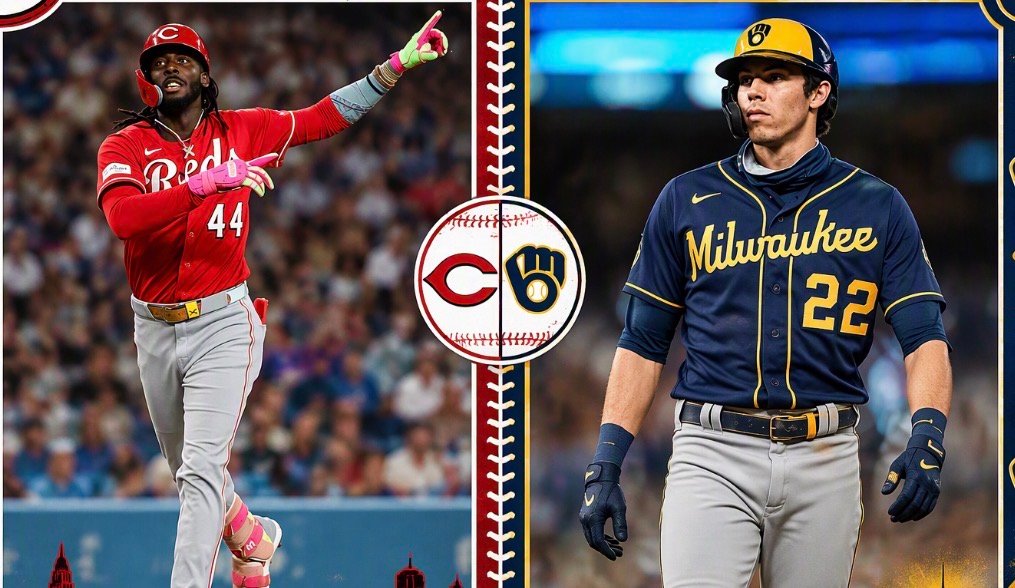

Imitation is said to be the highest form of flattery.
And nowhere would that be more true than in the National League Central where the Cincinnati Reds just saw their rivals the Milwaukee Brewers win their very first World Series championship in the franchise’s 57-year history. They had the pleasure of watching it from the comfort of their couches, armed with the unfortunate knowledge that their own last playoff series win is now 31 years in the rear view mirror.
How did the Brewers do it?
Why can’t the Reds do it?
Though they are simple questions, the answers have flummoxed Cincinnati’s ownership group, front office, and coaching staffs for decades.
But excellent Reds minds and beat writers have gone into significant organizational detail about the failings fans have had to endure for the 23 year span of the Castellini era. And those failings, and the Brewers’ successes, have been thrust back into the light after this week’s World Series title.
And while those articles do a great job explaining the structural differences in the clubs’ operations, it’s also interesting to see the specifics of how that played out on the field in 2026 and past years.
2026 Was A Tale of Two Different Teams
Milwaukee faced early adversity in 2026, standing at 18-16 on May 4. But after that they became a juggernaut, going 85-43 the rest of the way.
The Reds went the opposite direction. After a scorching hot 20-11 start they imploded and finished 21 games under .500 for the remainder of their schedule, going 55-76 to end the year at 75-87.
The Brewers Are Just Built Different From The Ground Up
And there are plenty of reasons for that divergence, but nowhere is that more evident than in the way each team operates. Principal owner Mark Attanasio said it best last season when he commented on the Brewers’ small market status. “I wonder if we had more money to spend, if we wouldn’t make more mistakes,” he said. “Organically, in every one of our transactions, we look forward three years. We can’t afford to make mistakes because it sets you back for a long time.”
Reds fans know just how true this is, especially after the “big time” signings of the likes of Mike Moustakas, Jeimer Candelario, and Shogo Akiyama, all who fizzled out without having any real impact on the team for all of the money they were paid.
In addition, the Brewers simply identify talent so much better than most teams in baseball, including Cincinnati. Milwaukee acquired Christian Yelich from the Miami Marlins in January 2018 for four prospects who have barely made a dent in the major leagues. Meanwhile, Yelich won an MVP in 2018 and has been one of the best players in baseball until very recently.
And let’s not forget about the ace, Jacob Misiorowski, who the Brewers took in the second round of the 2022 draft out of Crowder College in Neosho, Missouri, all he has done this season is lead the league in ERA (1.80) and strikeouts (252) while going 16-5.
William Contreras was an all-star when Atlanta dealt him to Milwaukee as part of a December 2022 three-team trade. This season Contreras hit .270 and had an OPS of .758 along with 18 home runs. And in the postseason this year he was wrecking things hitting over .350 with an OPS of over 1.15.
And the last of what could be a dozen examples of finding value and upside is Trevor Megill. After the Minnesota Twins designated him for assignment in April 2023, the Brewers acquired the reliever for a player who still has yet to appear in a major league game. After his pickup, Megill has recorded 81 saves over the last three seasons and was an All-Star in 2025.
And even with superior front office work and talent acquisition it hasn’t been easy for Milwaukee as they so often fell to the big-money juggernauts after dominating in the regular season. In 2025 they won 97 regular season games but were swept by the Dodgers. The year before that they won 93 games but lost in the Wild Card Series.
2026 was different, though, as they found a way to dominate in both the regular and postseasons.
The Brewers Torched 2026 While The Reds Collapsed
The Brewers finished with a .258 team batting average, ranking first in Major League Baseball, and also led the league with a .341 on-base percentage. Their 107 wRC+ was one of the best in baseball as well.
Cincinnati, meanwhile, had plenty of power but simply couldn’t generate consistent offense. They ranked fourth in MLB with 213 home runs, but their .228 team batting average was dead last. A .305 on-base percentage and 91 wRC+ highlighted just how hard it was for them to get runners on.
The gap between Milwaukee and the Reds was equally as striking when it came to pitching. The Brewers ranked second in MLB in both team ERA and strikeout rate, finishing second overall in total strikeouts with 1,331, trailing only the Philadelphia Phillies. Cincinnati on the other hand had a 4.83 team ERA, ranking 28th. It was the same story for the bullpen. According to Covers Bullpen Stat Indexes, Milwaukee ranked second in MLB with a 3.40 bullpen ERA with 55 saves. Cincinnati’s bullpen ranked 28th according to Inside the Pen Bullpen ERA Index, with a 4.58 ERA.
Doing More With Less Makes All The Difference
Doing more with less is probably the number one requirement of a small market front office. The Reds simply cannot make this work and haven’t been able to do so for a long time. Though Cincinnati’s payroll is lower than Milwaukee’s ($128,223,748 – 20th vs. $146,206,320 – 19th), the return on investment is all that much lower. For all that the Brewers have excelled, the Reds have faltered.
They have not won more than 90 games since 2013, and from 1998 through 2024, franchises other than the Reds have won 951 postseason games. The Reds won a grand total of two during that span.
The Reds don’t need to copy the Brewers. But they do need to show that after watching one of the most cost effective franchises topple some of the biggest spenders in the game that they’ve learned something. That they’ve realized that the way they have operated for over two decades must change.
That’s all we ask, but if those pleas continue to fall on deaf ears then the dark times at Great American Ballpark may continue for quite a long time.

